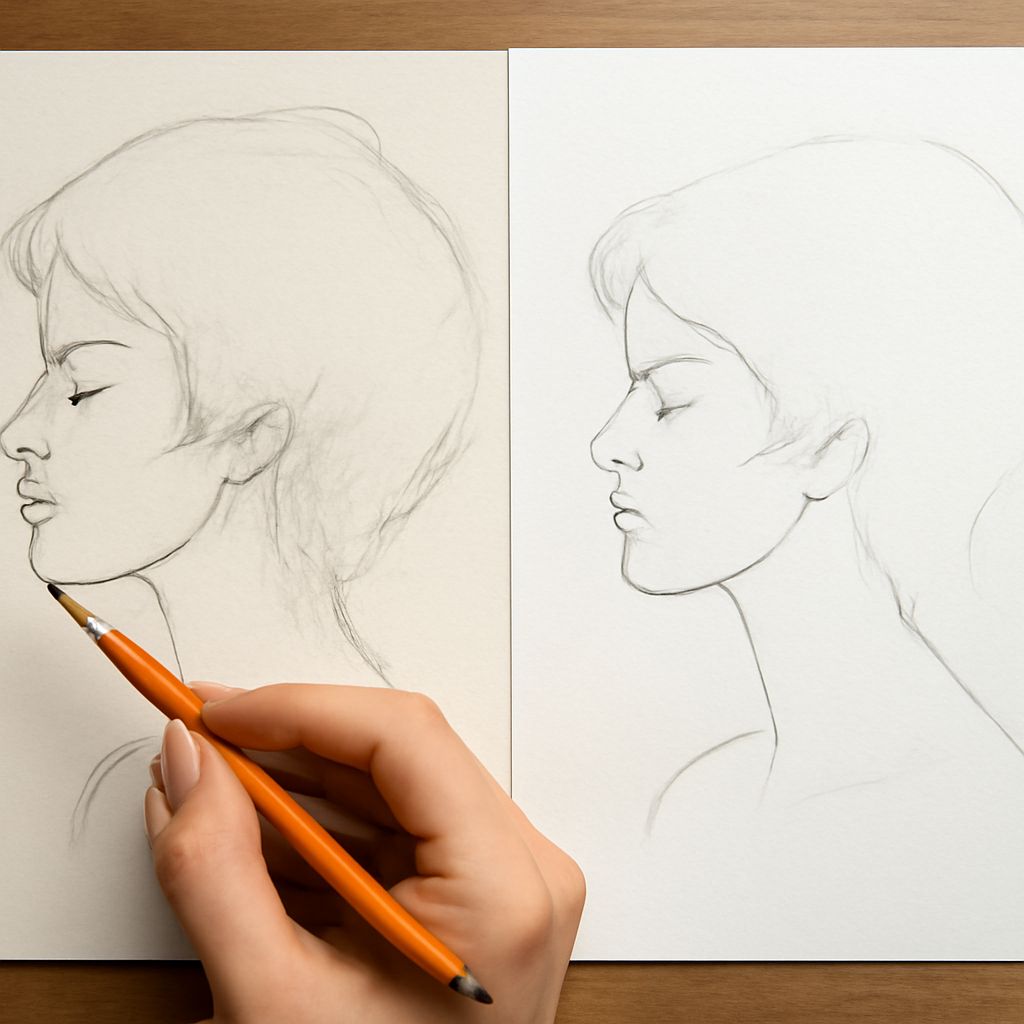
A line only a fraction of an inch out of place can change the expression of a face or the angle of a roof. When you transfer a finished sketch onto canvas, the goal is to preserve the relationships between marks while leaving a guide light enough to paint over.
Graphite transfer paper gives you a direct way to move a drawing onto a prepared canvas at the same size. A hinged sheet lets you inspect the lines as you work and return the drawing to the same position for corrections.
How to Transfer a Drawing to Canvas: Choose Your Materials
Gather your finished drawing or a clean working copy, graphite transfer paper, a sharp pencil or blunt stylus, removable artist’s tape, and a kneaded eraser. Use a canvas already prepared for your painting medium. A copy is helpful if you want to protect the original from the pressure of tracing or from tape.
For this transfer from paper to canvas, choose graphite paper intended for artists and check its directions. Winsor & Newton recommends placing the graphite side against the canvas and keeping both sheets still while tracing. Make a small test on a spare piece of similarly prepared canvas: check that the line is visible, can be lightened, and behaves acceptably beneath the paint you intend to use. A dark line can show through a thin, pale layer of paint.
A home-made alternative is to rub a soft graphite pencil over the back of a working copy wherever the main lines fall. Place that side against the canvas and trace from the front. Test it first, since a heavily coated backing can smudge and leave a dark patch. Commercial transfer paper makes it easier to cover a larger area evenly.
Position and Hinge the Drawing
Lay the canvas on a stable surface. For stretched canvas, place a clean, smooth board beneath the fabric inside the stretcher so it supports the area you will trace without stretching or denting it. Keep the canvas level and remove loose dust with a clean, dry cloth.
Place the drawing face up on the canvas. Before attaching it, compare the margins at the top, bottom, and sides; check where important features sit relative to the canvas edges. If a figure’s head needs a certain amount of space above it, measure that space now. Moving a drawing to canvas is much easier when the position is settled before any line is traced.
Attach the top edge of the paper with small pieces of artist’s tape to make a hinge. Test the tape on an inconspicuous edge first, and attach it where removal will not damage the surface. Lift the drawing like a page and slide the transfer paper beneath it, coated side facing the canvas. Secure the transfer paper so it cannot slide, while keeping the drawing’s hinge free to lift. Leave a small section accessible for an early check.
Trace and Check in Stages
To learn how to transfer a drawing to canvas accurately, start with a few widely spaced landmarks: the top and bottom of the subject, a corner, and a distinctive intersection. Trace with steady, moderate pressure. Press hard enough to leave a visible line, but not so hard that you score the paper or strain the canvas.
Lift the drawing from the lower edge while leaving the hinge attached. Check that the first marks are visible and located where you intended. If a line is too faint, lower the sheet carefully and trace it again with slightly more pressure. If it is too dark or has smudged, lighten the test mark and adjust your pressure or transfer material before continuing.
Once those landmarks align, trace the outer contours and major internal divisions. Work from one area to the next, holding the layers steady with your free hand. On a complex image, pause at intervals and lift the hinged sheet to check progress. Your aim when copying a drawing onto canvas is a readable map, not a duplicate of every shade or pencil texture. Leave out small details that you plan to resolve with paint.
Inspect the Result Before Painting
Before removing the hinge, compare several points across the whole image. A successful drawing transferred to canvas has matching proportions, connected contours, and landmarks that sit in the intended positions relative to the edges. Look for a missing line at an overlap, a contour that stops unexpectedly, or two marks that should meet but do not.
If you are unsure how to transfer a drawing to canvas without creating heavy outlines, remember that each mark only needs to remain visible through your first painting decisions. Lift excess graphite gently with a kneaded eraser, testing on a spare surface first. Avoid vigorous rubbing that could disturb the canvas surface. Once you are satisfied, remove the tape slowly and keep the paper copy nearby as a reference.
The most likely problem is a shift between checks: a contour appears doubled, or a line no longer meets its neighbor. Leave the hinge attached, lift the drawing, and compare the last correct landmarks. Reposition the sheet and transfer paper to those marks, secure them again, and lightly remove the misplaced line before retracing that section. If the hinge has already come loose, align several distant landmarks before you tape the sheet back down.