What’s the best flower to start with when you’re learning to draw? Many artists and instructors land on the daisy — and for good reason. A daisy flower drawing breaks down into clear, manageable components: a circular center, radiating petals, and a simple stem with leaves. That structure makes it the ideal entry point for anyone working through flower drawing step by step, while still offering enough visual variation to challenge more experienced hands. Realistic flower drawing of a daisy involves observing subtle petal overlaps, foreshortening, and the texture of the seed head — none of it overwhelming, but all of it genuinely instructive.
This guide covers the full progression: from basic daisy shapes suited to a drawing for beginners step by step approach, through naturalistic rendering techniques, into stylized formats like kawaii drawings step by step. Whether you’re sketching in a notebook, working in watercolor, or building a digital illustration practice, you’ll find techniques here that translate across media.
Understanding Daisy Structure Before You Draw
The Center Disc
Every daisy starts with its center disc — a slightly domed, roughly circular shape covered in tiny florets. When you approach a daisy flower drawing from observation, notice that the disc isn’t perfectly flat: it curves outward toward the viewer, and the florets at the edge of the disc face slightly outward rather than straight up. This dome shape is what creates the three-dimensional quality that separates a convincing daisy drawing from a flat, symbol-based one.
Petal Arrangement and Overlap
Daisy petals — technically ray florets — radiate outward from the central disc in a single layer. They’re not perfectly uniform: natural daisies have petals of slightly varying widths, lengths, and angles. Some petals overlap slightly at their bases. When you’re working on a realistic flower drawing of a daisy, capturing this subtle irregularity is what makes the result feel alive rather than mechanical. Draw your petals with minor variations in shape rather than identical duplicates rotated around the center.
Stem and Leaf Details Daisy stems are sturdy, slightly hairy, and often curved under the weight of the flower head. The leaves are elongated with slightly toothed margins. In a complete flower drawing step by step approach, the stem and leaves often get rushed — but they contribute significantly to the composition’s naturalism. Study how the stem attaches to the base of the flower head, and how the leaf surface catches light differently from its underside.
Drawing for Beginners: Simple Daisy Step by Step
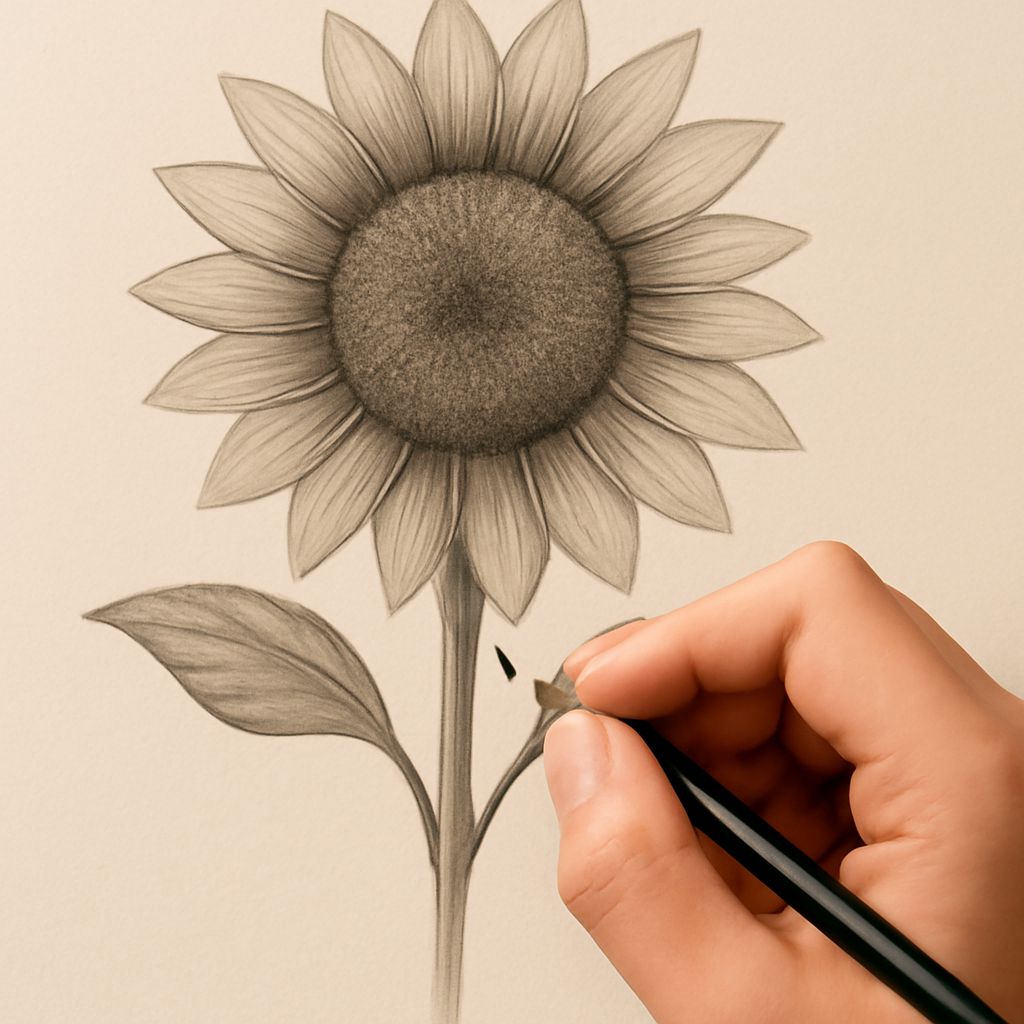
Start with a light pencil circle for the center disc. Draw a slightly smaller oval or circle inside it to represent the domed top surface. Radiate eight to twelve petal shapes outward from the disc, spacing them roughly evenly but allowing for small irregularities. Each petal is a simple elongated oval that narrows toward the base and rounds at the tip. Draw a curved line for the stem and add two or three leaves.
This drawing for beginners step by step method works well as a first exercise because it trains you to build a complex shape from simple components — a foundational skill that applies to every other subject you’ll draw. Once you’re comfortable with this basic structure, you can add detail incrementally: texture to the disc surface, tonal shading on the petals, more specific leaf shape.
Realistic Flower Drawing: Adding Depth and Detail
Value and Shading on Petals
Realistic flower drawing requires you to observe where light falls across each petal and shade accordingly. Petals that face the light source are lighter; petals in shadow or overlapped by other petals are darker. The shading on a white daisy petal is subtle — you’re working in a very compressed value range from near-white to light gray. Use a sharp 2H pencil for the lightest areas and an HB for shadow areas, blending with a tortillon for soft transitions.
Rendering the Center Disc
The center disc of a daisy flower drawing is one of its most visually interesting features up close. The individual florets create a packed, slightly bumpy texture that reads as a pattern from a distance. For a realistic rendering, use a stippling technique in the shadow areas and leave the lit florets on the domed surface lighter. The edge between the disc and the petals is a crisp value transition — darkest at the point where the white petal base meets the yellow-green disc edge.
Kawaii Drawings Step by Step: Cute Daisy Style
Kawaii drawings step by step takes a different approach to the same subject. Rather than accurate botanical rendering, kawaii style simplifies and exaggerates toward cuteness: a large, circular center with simple dot eyes and a small smile, very rounded petal shapes with minimal overlap, and a thick, gently curved stem. The color palette tends toward soft pastels — pale yellows, pink whites, sage green.
When adapting your daisy flower drawing to kawaii style, the key shift is from observation to design thinking. You’re making choices about what will read as cute and approachable rather than what accurately represents the plant. Larger center relative to petals, fewer petals with more space between them, and soft rounded contours all contribute to the kawaii aesthetic. Practice the kawaii approach separately from your realistic studies rather than trying to merge them — they use different parts of your visual thinking.
Watercolor Techniques for Daisy Drawings
Watercolor is one of the most popular media for realistic flower drawing, and daisies translate well to the medium. Start with a light pencil sketch, then work wet-on-wet for the center disc to create soft, blooming texture. Paint the petals individually with a diluted neutral wash, leaving hard-edged highlights where the light hits most directly. Build shadow values on the underside of petals with a slightly warmer gray — a mix of ultramarine and burnt sienna in a diluted wash.
The challenge with white flower drawing in watercolor is that you’re painting the shadows, not the petals themselves — the paper is your white. Plan your highlights before you apply any paint and protect them by leaving them dry throughout the process. Masking fluid can help if you find it difficult to paint around precise white areas, though many artists prefer to work without it once they develop sufficient brush control.