What if mastering figure drawing was less about learning to draw people and more about learning to see shapes? Drawing shapes is the fundamental skill that underlies every complex illustration, and once you internalize this principle, the way you look at the world — and the way you draw it — changes permanently. Whether you’re practicing simple shape drawings for the first time or tackling the complex challenge of drawing body shapes for figure work, the same core principles apply.
This guide takes you from the most basic drawing with shapes exercises all the way to applying that foundation to the human figure. You’ll build practical skills in drawing basic shapes with confidence, then discover how those same forms become the building blocks for portraits, gestures, and full compositions.
Why Drawing Shapes Is the Foundation of All Art
Every object you’ll ever draw — a tree, a building, a face, a hand — can be broken down into combinations of basic geometric forms. A head is a modified sphere; a torso is a modified cylinder; a box is a collection of rectangles in perspective. When you approach drawing with shapes as your primary conceptual tool, you replace the overwhelming task of “drawing a person” with the manageable task of “arranging and connecting familiar geometric forms.”
Simple shape drawings also teach you to see in terms of mass rather than outlines. Most drawing beginners focus on the edges of objects; shape-based drawing trains you to think about the three-dimensional solidity of each form before considering how its edges appear from a given viewpoint. This shift in perception is transformative and permanent.
Drawing Basic Shapes with Confidence
The Core Geometric Forms There are five fundamental forms in drawing basic shapes: the sphere, the cylinder, the cone, the cube, and the rectangular prism. Every shape in nature and architecture is a variation or combination of these five. Practice drawing each form from multiple viewpoints — straight on, from above, from below, at three-quarter angle — until you can place them convincingly in space without reference.
Drawing with shapes at this foundational level requires you to indicate the three-dimensional nature of each form, not just its outline. Add an ellipse to the top of your cylinder; shade the underside of your sphere; show the receding planes of your cube. These additions turn flat symbols into convincing three-dimensional objects.
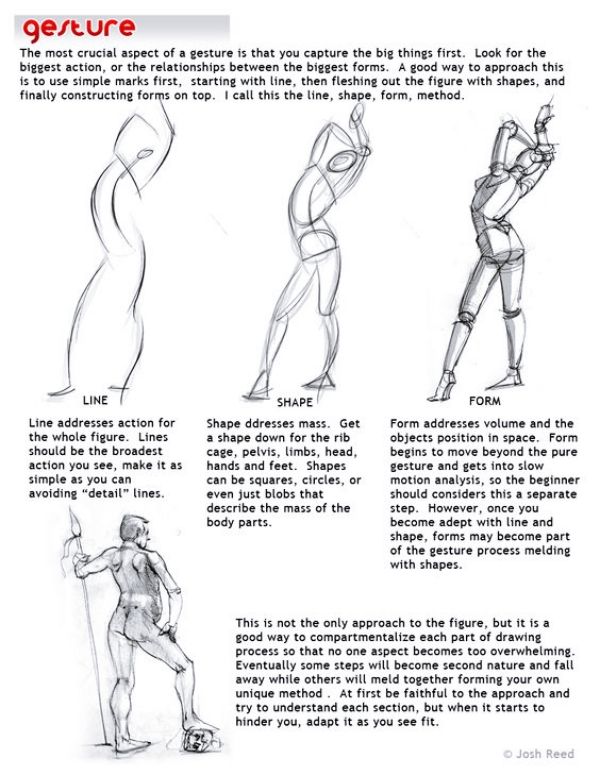
Gesture and Shape Relationship
Once your individual shapes are solid, practice connecting them. Simple shape drawings that combine two or three forms — a sphere on a cylinder, a cone on a cube — force you to solve the problem of how shapes meet and overlap in space. This directly prepares you for figure drawing, where the head (sphere-like) connects to the neck (cylinder) connects to the torso (modified box or egg).
Drawing Body Shapes for Figure Work
The transition from abstract drawing basic shapes to drawing body shapes is shorter than you might think. The key insight is that the human figure is not a outline to be copied but a collection of masses to be understood in space. The head is roughly egg-shaped, wider at the back than the front. The ribcage is an ovoid that tilts slightly back. The pelvis is a basin shape that tilts in the opposite direction. The limbs are cylinders that taper toward the joints.
Practice drawing body shapes in quick gesture sessions of thirty seconds to two minutes. At this pace, you can’t render details — you can only capture the large masses and their relationships to each other. After each gesture, ask yourself: did each major shape feel three-dimensional, or did the figure flatten out into an outline? Use that feedback to sharpen your next attempt.
Advanced Drawing with Shapes: Foreshortening and Perspective
The real test of shape-based drawing comes when forms overlap and foreshorten. Drawing with shapes gives you a powerful tool here: when a limb points directly toward you, its cylindrical form appears as a foreshortened ellipse rather than a long rectangle. When you understand the cylinder conceptually, the foreshortened version makes immediate sense rather than looking inexplicably strange.
Apply perspective principles to your body shapes directly. A figure walking away from you has smaller shapes in the distance; a figure reaching toward you has an enlarged hand shape in the foreground. These spatial relationships are much easier to manage when you’re thinking in geometric masses rather than trying to reproduce every surface detail of the figure simultaneously.