How do you make a flat drawing feel three-dimensional without shading or color? Cross contour drawing is one of the most powerful answers to that question. By following the surface of a form with lines that wrap around rather than outline it, you create the illusion of volume through direction alone. This technique sits at the heart of foundational art education, and understanding it changes how you see every other drawing method. Cross hatching drawings are a related discipline that builds on the same principle, using intersecting lines to create tone rather than form description.
This guide covers cross contour line drawing from its theoretical basis through practical application, explores how cross contour drawings differ stylistically from cross hatching, and takes a detour into the ornate world of celtic cross drawings — a tradition that uses contour logic in decorative rather than representational ways.
What Cross Contour Drawing Actually Does
A contour line traces the outer edge of a form. A cross contour line crosses that edge and wraps over the surface, following the hills and valleys of the object like topographic lines on a map. When you look at an orange and draw lines that follow its roundness from top to bottom, you’re drawing cross contours. Those lines communicate curvature — the viewer’s eye reads them as evidence of a three-dimensional surface.
Cross contour drawing exercises appear in nearly every introductory drawing curriculum because they break the habit of outlining and teach students to think about form in three dimensions. You’re not recording what you see at the silhouette edge; you’re recording the shape of the entire surface.
Cross Contour Line Drawing in Practice
The practical challenge of cross contour line drawing is maintaining consistent line density and curvature that accurately describes the form. Lines that are too evenly spaced look mechanical. Lines that curve incorrectly or at inconsistent rates misrepresent the form’s actual shape.
Choosing Your Subject
Simple curved objects work best for early practice: a sphere, an egg, a crumpled piece of paper, a human hand. These give you clear, readable surface curvature to follow. As your observation improves, move to more complex subjects like the human face or a piece of draped fabric where surface direction changes rapidly.
Varying Line Weight
Lines on the surface nearest you should be slightly heavier than lines receding into space. This subtle variation reinforces the three-dimensional reading without adding literal shading. Cross contour drawings that use uniform line weight throughout often feel flat despite technically correct direction. Varying pressure by just 10 to 20 percent creates significant spatial depth.
Combining with Contour Outline
Many artists combine a silhouette contour with interior cross contours for maximum clarity. The outer edge grounds the form, while interior lines describe the surface. This combination appears frequently in product design sketching and medical illustration, where both recognition and three-dimensional description are required simultaneously.
Cross Hatching Drawings and How They Differ
Cross hatching drawings use intersecting sets of parallel lines to build tone. Unlike pure cross contour work, cross hatching’s primary goal is value — light and dark — rather than form description. However, the best cross hatching does both: lines that follow surface direction while also varying in density to create shadow.
The tradition of cross hatching drawings goes back to engraving and etching, where the pressure and direction of each line had to be decided in advance. Old Master printmakers like Albrecht Dürer created extraordinary depth using only line direction and density. Studying their work remains one of the fastest ways to understand how cross hatching can describe both form and light simultaneously.
Celtic Cross Drawings: Decorative Contour Logic
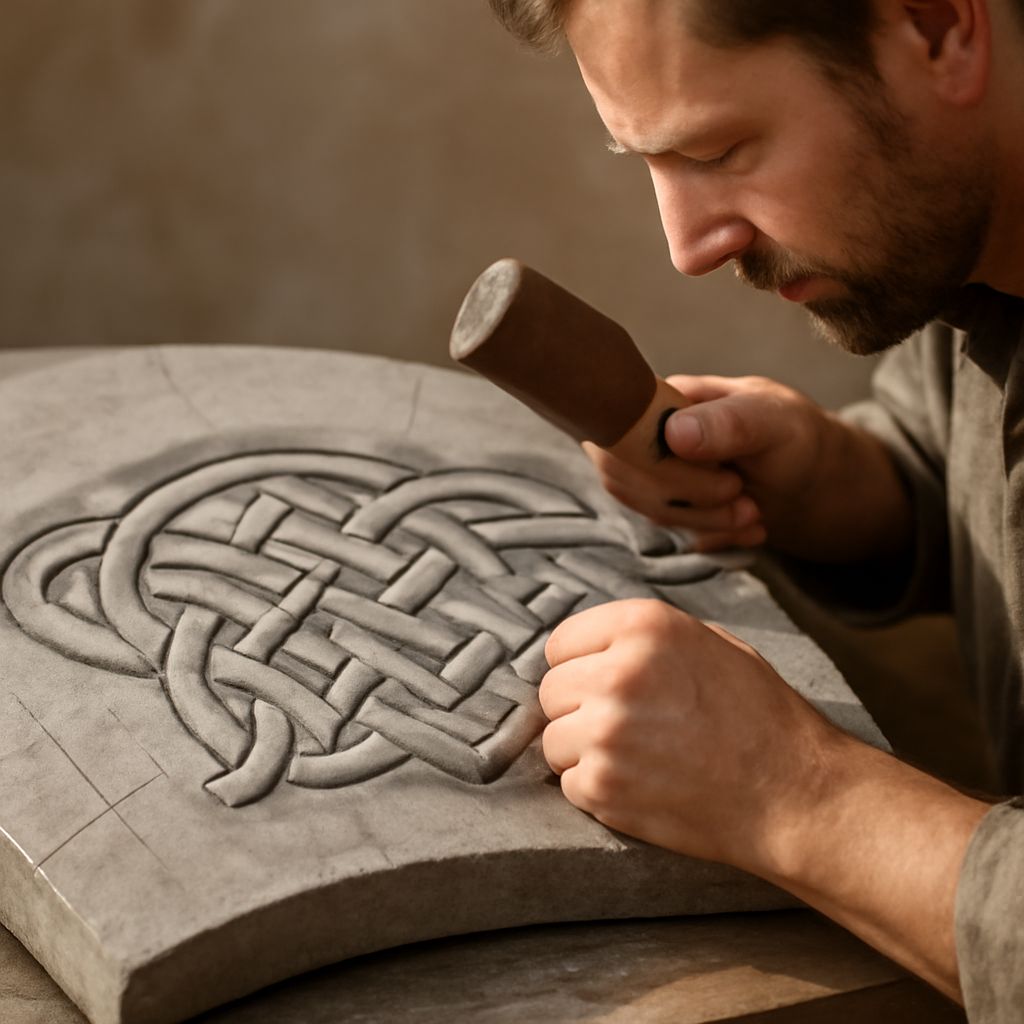
Celtic cross drawings represent a completely different application of line — one where interlacing paths create the visual equivalent of cross contour, but in purely geometric and symbolic terms. The knotwork patterns that fill a traditional Celtic cross follow strict over-under rules, with each ribbon passing alternately above and below every intersection.
Drawing celtic cross drawings from scratch requires grid planning. Start with a symmetrical grid, then connect points with continuous bands that maintain the over-under alternation. The result looks organic and complex, but follows strict geometric rules. The visual rhythm of Celtic knotwork has influenced tattoo design, jewelry, and typography for centuries, and the underlying logic is essentially a stylized form of cross contour — lines that map a surface according to a consistent rule system.
Applying These Techniques Together
The most interesting work emerges when you combine these approaches. Try applying cross contour line drawing logic to decorative subjects — draw the curved surface of a Celtic cross as if it were a three-dimensional object, using cross contours to describe the relief of raised knotwork. Or use cross hatching density to add shadow to cross contour studies, combining the tonal power of hatching with the spatial clarity of contour direction.
Practice cross contour drawings for ten minutes before every drawing session as a warm-up. Choose a simple object and fill its surface with carefully observed cross contour lines. Over weeks, you’ll notice your spatial thinking becoming more automatic — the three-dimensional intelligence that cross contour drawing builds transfers to every other kind of drawing you do.