V Logo Design: A Complete Guide to Letter V Branding
What makes the letter V such effective raw material for logo design? The V shape carries inherent visual energy — two diagonal lines meeting at a point naturally suggest forward motion, precision, and convergence. A well-designed v logo can communicate victory, velocity, vector, vision, or value through letterform alone, before any color or supporting element is added. V logos appear across industries from automotive to finance to sportswear precisely because the shape is versatile and immediately legible at any scale. Whether you’re designing logos with v for a new brand from scratch or evaluating existing options for a rebrand, understanding what makes a letter v logo work separates effective design decisions from aesthetic guesswork.
This guide covers design principles specific to v logos, explores how two letter logos using V work, examines what distinguishes strong v logos from weak ones, and provides practical guidance for building your own v logo design.
The Visual Language of the Letter V
The letter V’s geometry is unusually rich for logo purposes. The two diagonal strokes and the central vertex give you multiple angles to work with — the stroke angle, the vertex angle, and the overall proportions of the form. Narrow V shapes feel sharp and aggressive; wider V shapes feel stable and open. Rounded vertex treatments soften the form toward approachable or organic, while a perfectly angular vertex pushes toward precision and technology.
When you look at famous v logos across different industries, you can read these design decisions directly. A tech company’s v logo typically uses thin strokes and a tight vertex angle to suggest precision and cutting-edge quality. A sports brand’s v logo uses heavier strokes and bolder proportions to communicate power and energy. These are not arbitrary choices — they’re the same form-meaning relationships that inform all successful lettermark design.
Designing Effective V Logos: Key Principles
Stroke Weight and Proportion
The relationship between stroke width and the overall size of the V determines much of its personality. Thin strokes at elegant proportions read as luxury or technology. Bold strokes at condensed proportions read as strength and athleticism. For most v logos, a medium stroke weight offers the best balance of legibility across sizes and personality flexibility. Test your v logo design at very small sizes — 16px favicon territory — to make sure the stroke weight holds up and the vertex remains legible.
Customizing the Letterform
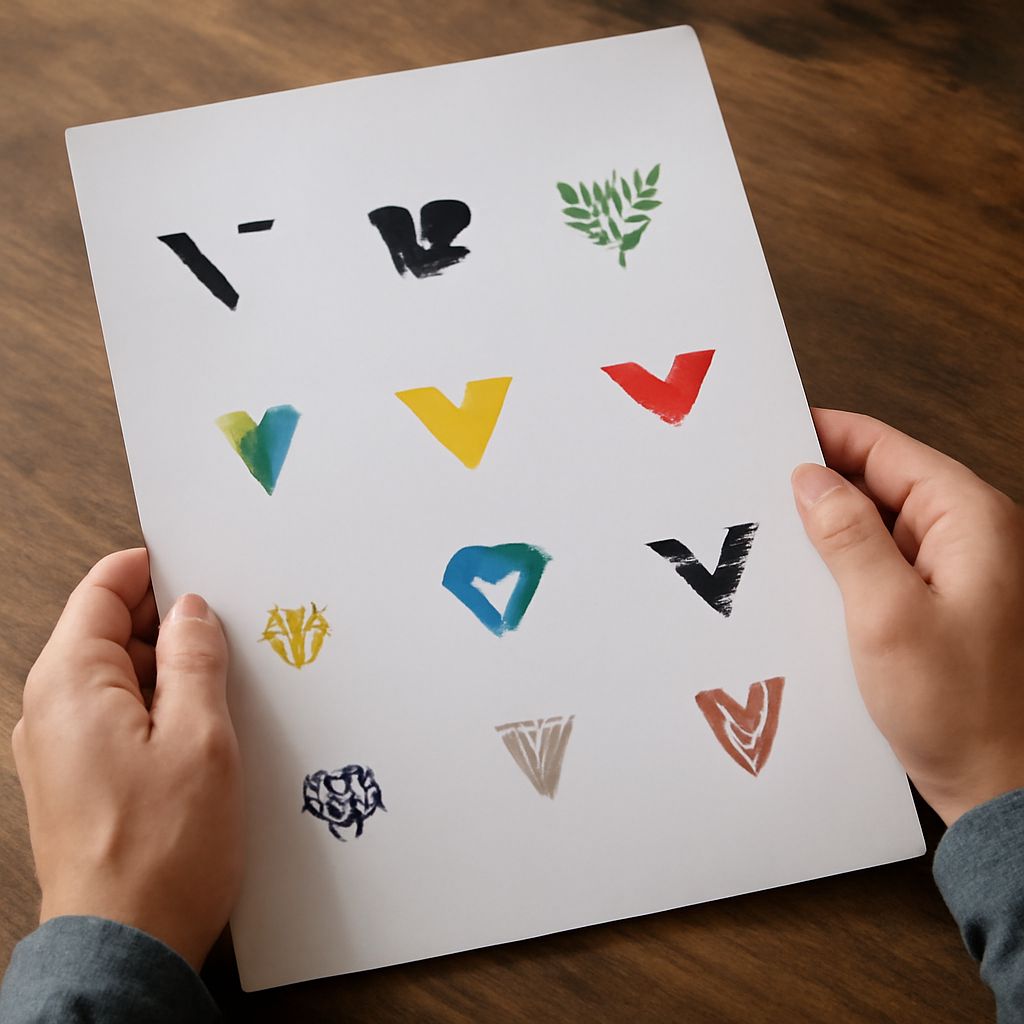
The most distinctive letter v logo designs don’t use a standard typeface V — they customize the letterform to carry brand-specific meaning. The vertex might become a negative space element, an arrow, a checkmark-like flourish, or an abstract icon. The ends of the strokes might terminate in cuts, serifs, or curved finials that connect the letterform to the brand’s visual language. These customizations are what separate a professional logo from a font choice dropped into a square.
Color and Contrast
V logos work in single color with the strength of the letterform alone, which is a good test of any lettermark design: if it can’t communicate clearly in flat black on white, it isn’t ready for color. Once the monochrome version is resolved, color can add brand personality, industry signaling, or emotional temperature. Dark backgrounds often work well with V logos because the diagonal strokes create interesting negative space that reads differently on dark than on light.
Two Letter Logos Featuring V
Two letter logos that include V offer additional design flexibility because the second letter can interact with the V’s geometry in interesting ways. The diagonal strokes of the V can share space with letters like A, M, or W that have complementary diagonal geometry. Letters with strong vertical strokes (I, L, T, H) can anchor against the V’s angles to create balanced, stable compositions. Two letter logos using V and a curved letter (C, G, O, Q) create contrast between angular and curved forms that can be visually compelling if handled carefully.
When designing two letter logos with V as one element, decide whether the V dominates or whether the two letters hold equal visual weight. Equal weight usually requires careful size balancing and shared stroke width. Dominant-V arrangements let the letter’s visual strength carry the composition with the second letter providing context or completing an abbreviation.
Logos with V Across Industries
Logos with V appear in enough industries and contexts to demonstrate how adaptable the letterform is. In automotive branding, V-shaped logos evoke engine configurations (V8, V12) as much as they evoke letter identity. In technology, V logos appear at companies where the name begins with V and the forward-pointing geometry reinforces the brand’s innovation messaging. In fashion, V logos convey a certain minimal elegance — the letterform alone, perfectly proportioned, needs nothing else to communicate quality.
Looking across all these contexts, the consistent factor in effective v logos is intentionality: every design decision from stroke weight to vertex angle to color has been made deliberately rather than defaulted to. The strongest letter v logo designs look inevitable — as if no other visual solution could have served the brand as well.
Building Your V Logo: Practical Steps
Start with the letterform in vector software. Draw the V from scratch using the pen tool rather than typing it in a font and modifying — this forces you to make every proportion decision deliberately. Set your vertex angle first (narrow for tech/precision, wider for consumer brands), then establish stroke weight, then decide on terminal treatments. Once the basic form reads well in isolation, test it in context: on a dark background, at small size, in a horizontal lockup with a wordmark, and as a standalone icon.
The best v logo designs go through at least three rounds of revision — initial concept, refinement based on size testing, and final polish based on context testing. Rushing past this process produces logos that look good in a single presentation view but fail in actual use.