Drawing Exercises: A Structured Practice Plan for Real Improvement
What separates artists who improve steadily from those who practice regularly but plateau? Almost always, it’s the difference between deliberate drawing exercises and undirected time at the sketchbook. Drawing practice exercises target specific skills — line control, proportion accuracy, value range, spatial reasoning — with the explicit goal of building those skills rather than just producing finished work. Drawing excercises (to use the common alternate spelling) appear in the curriculum of every serious art program because unfocused practice reinforces what you already know; targeted exercise develops what you don’t. If you’re looking for drawing practice ideas that will produce measurable improvement rather than just more pages, this guide gives you a structured approach.
The exercises here work across media — pencil, pen, digital — and across skill levels. Each targets a specific aspect of drawing that determines whether your work reads as skilled or hesitant, accurate or approximate.
Line Control Exercises
The Straight Line Challenge
Drawing a straight line freehand — without a ruler — seems simple until you actually try to do it consistently. This is one of the most fundamental sketch exercises in any serious program: draw fifty parallel horizontal lines across a page, aiming for evenness of spacing and straightness of line. Then do the same with vertical lines, then diagonals. What you’re training is the controlled, fluid arm movement that produces confident, definite marks — as opposed to the tentative, scratchy line that signals uncertainty to every viewer. This exercise takes ten minutes and produces immediate, visible results when done daily for two weeks.
Ghosting Method
The ghosting method — rehearsing a stroke through the air before putting pen to paper — trains your muscle memory to execute a planned mark rather than a reactive one. Before drawing any line, move your hand through the full intended path three times without touching the paper. Then execute the stroke in one smooth motion. Drawing practice exercises built on this method produce significantly cleaner, more confident linework than approaches that just tell you to “practice more.”
Proportion and Observation Exercises
Negative Space Drawing
Drawing the spaces around and between objects rather than the objects themselves is one of the most effective drawing exercises for breaking habitual observation mistakes. When you draw a chair by focusing on the negative spaces between its legs and rungs, you bypass the symbolic chair-shape your brain wants to impose and actually observe the specific chair in front of you. This exercise works equally well with any complex object: plants, hands, bicycle frames.
Upside-Down Drawing
Copying a reference image placed upside down forces your brain to process it as shapes and relationships rather than as recognizable objects. This is a classic drawing practice exercise from Betty Edwards’s Drawing on the Right Side of the Brain and remains one of the most reliably effective observation exercises precisely because it disrupts the pattern-recognition habits that cause drawing inaccuracy. The results are almost always more accurate than right-side-up copies done by the same artist at the same session.
Value and Tonal Exercises
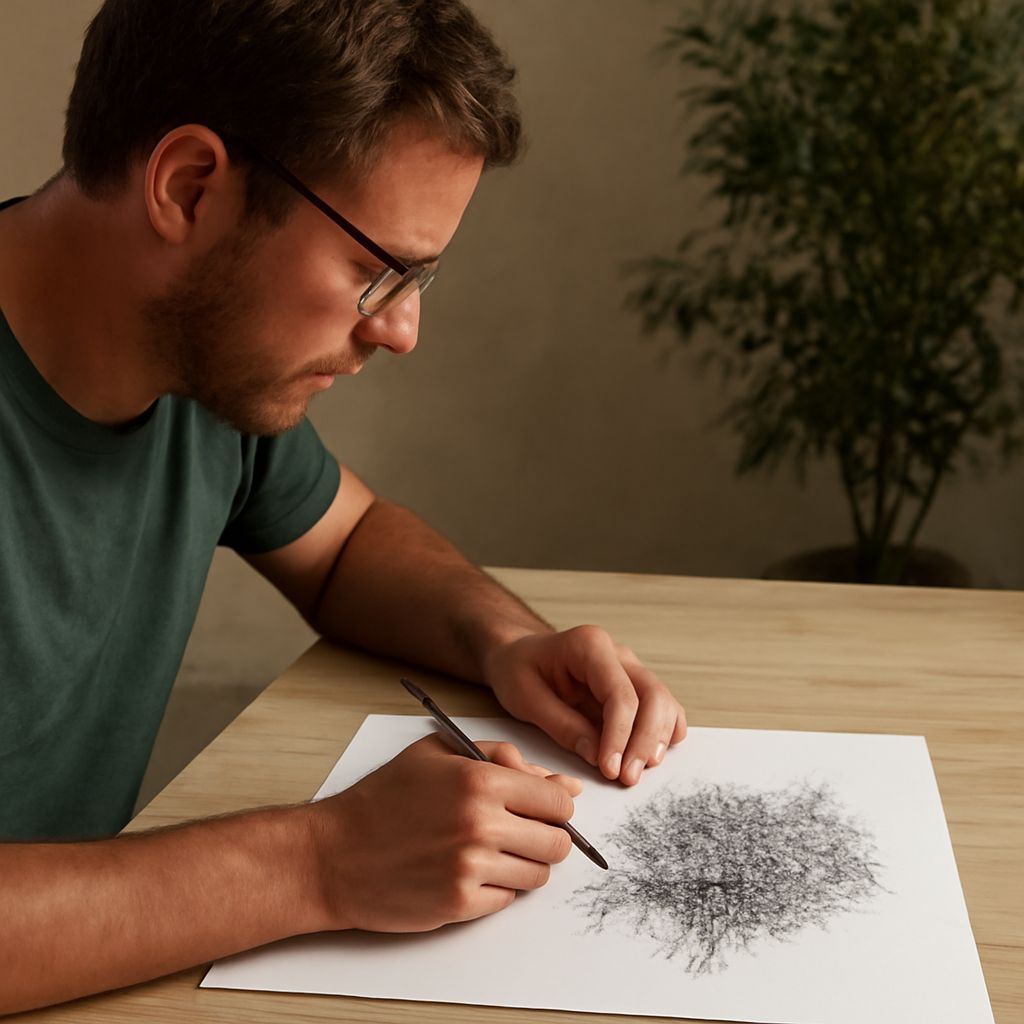
Value — the range from light to dark — is what makes drawings read as three-dimensional rather than flat. A targeted value drawing exercise: create a nine-step value scale from white to black using only two pencil grades (HB and 4B, for example). This exercise forces you to discover how much pressure variation and layering you can achieve with limited tools, and the result is a reference you can use to compare against your actual drawings when your values collapse into the midtone range.
A second value-focused exercise among the most useful drawing practice ideas: do a complete value study of a simple still life object — a single apple, a coffee mug — working only in two values (light and dark, no midtones). Then redo the same study in three values, then five. This progressive exercise trains your eye to see value structure before detail, which is the perceptual skill that underlies all convincing representational drawing.
Speed and Gesture Drawing Exercises
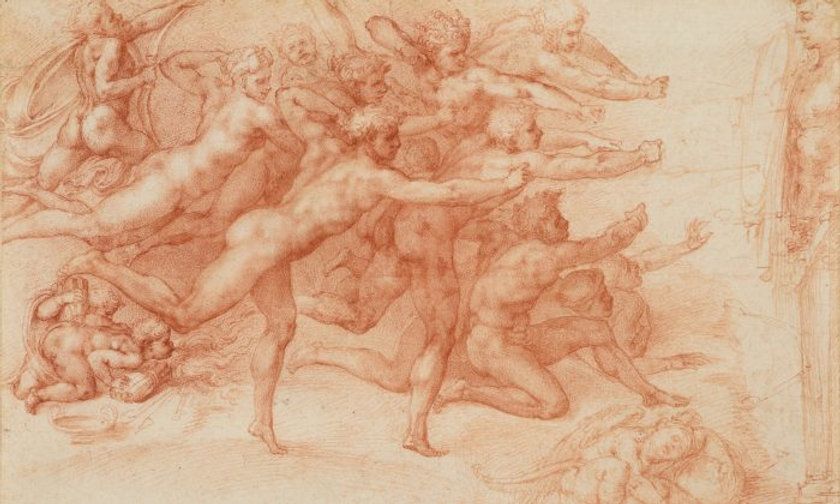
Timed gesture drawing is a group of sketch exercises that builds the foundation of all figure and observational work. Set a timer for thirty seconds and capture the essential energy of a pose in the fewest marks possible. Increase to one minute, then two minutes. The constraint of time forces you to identify what matters most in a pose rather than spending equal attention on everything. Websites like Line of Action provide randomized timed pose references specifically designed for this type of drawing practice exercise.
Building a Consistent Practice Schedule
Drawing exercises produce results only when done consistently. A realistic daily practice for someone with limited time: fifteen minutes of targeted drawing exercises (line control, value scales, or negative space) plus fifteen to thirty minutes of observational drawing from reference. That’s thirty to forty-five minutes total — a manageable commitment that, maintained for sixty days, will produce visible improvement in every aspect of your drawing that these exercises target.
Track your progress by photographing or scanning your exercise pages weekly. Comparison across weeks reveals improvement that’s invisible on a day-to-day basis — and seeing measurable progress is the single most effective motivation for maintaining a practice.
Bottom line: Drawing practice exercises and drawing excercises that target specific skills produce faster improvement than undirected sketchbook time. Build a weekly rotation that covers line control, proportion observation, value work, and gesture, and you’ll see consistent progress across all aspects of your drawing practice.