Stipple Drawing and Straight Line Drawings: Techniques and Inspiration
What do stipple drawing and straight line drawings have in common? Both rely on deliberate, repeated marks to build up tone, texture, and form without using freehand curves or loose hatching. Whether you’re working on stippling drawings for a science illustration or exploring straight line drawings as a meditative practice, the underlying discipline is the same: consistent mark-making applied with intention.
This guide walks through the core techniques for stipple drawings, explains how straight line work connects to them, and introduces the influence of artists like Balthus whose drawings rely on controlled line quality to create psychological depth.
Understanding Stipple Drawing
What Is Stippling
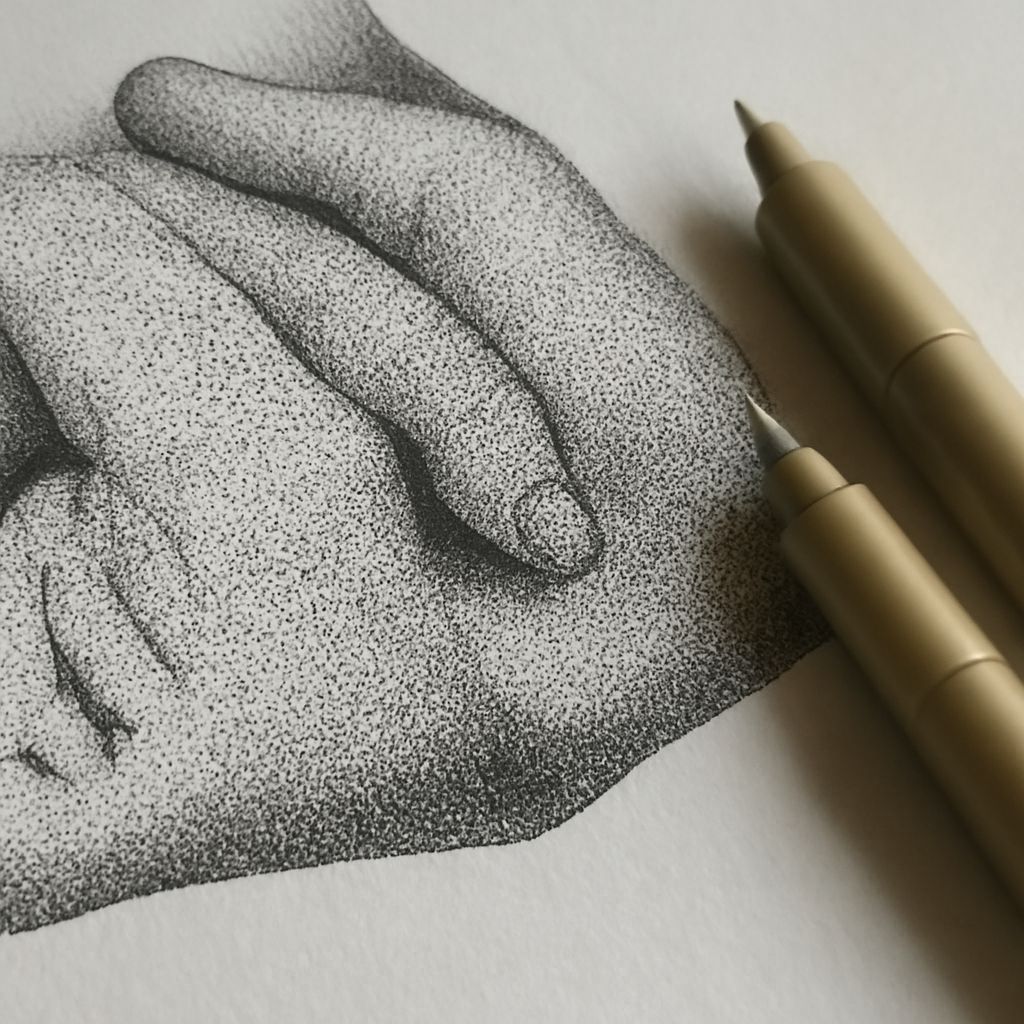
Stipple drawing is a technique where tone is built entirely from dots rather than lines or solid fills. Each dot is a small pressure mark, typically made with a fine-tipped pen. The density of the dots determines the value: closely packed dots produce dark areas, while sparse dots read as light. Stippling drawings have a distinctive grainy texture that is well suited to scientific and technical illustration.
The technique dates back to engraving traditions where stipple drawing was used to reproduce portraits and botanical plates. Modern illustrators still use it for natural history work because dots translate cleanly to print without the tonal shifts that hatching lines can produce in halftone reproduction.
Tools for Stippling Drawings
Technical pens with 0.1 to 0.3 mm nibs are the standard tool for detailed stipple drawings. The consistent line weight keeps each dot the same size, which is important for even tonal gradations. Ballpoint pens work for loose stippling but produce inconsistent dot sizes because pressure affects the line weight. Brush pens are less common in stippling but can produce interesting textured dot marks by barely touching the tip to the paper.
Building Tone with Stipple Drawings
The key to convincing stippling drawings is patience and consistency rather than speed. Start your darkest areas and work outward, spacing dots further apart as you move toward the light. Avoid crossing back over areas you’ve already stippled to add density; instead, plan your darkest values first and let them guide the rest of the tonal structure.
Practice stipple drawing on small studies before attempting large compositions. A simple sphere is the classic exercise. Place your densest dots on the shadow side and on the cast shadow, thin them out across the form, and leave the highlight zone completely clear. That single exercise teaches you to control three separate tonal zones with dots alone.
Straight Line Drawings as a Related Discipline
Straight line drawings share stippling’s emphasis on systematic mark-making but replace dots with ruled or carefully freehand straight strokes. Pure straight line drawings use no curves at all, representing even circular forms with short tangent lines. The effect is angular and graphic, somewhere between technical illustration and Op Art.
Some artists use straight line drawings as a warm-up exercise to build steadiness in the hand. Running parallel lines at consistent spacing and consistent pressure without a ruler is harder than it sounds and directly improves control in all other drawing media.
Balthus Drawings and Controlled Line Quality
Balthus drawings are a compelling reference point for any study of controlled mark-making. The Swiss-French painter’s preparatory drawings show a deliberate, slow line that accumulates quietly over the surface. He rarely scribbled or improvised; every stroke has a clear purpose. His line quality sits between the measured control of academic drawing and a more personal, searching quality.
Studying Balthus drawings is useful specifically because his line work avoids the two most common student mistakes: overworking through nervous re-tracing and underworking through timid, broken strokes. His marks are complete, placed once, and left alone. That commitment to each individual mark is the same discipline required for good stipple drawing.
Combining Both Techniques
You can mix stipple drawing with straight line drawings in a single composition. Use straight line hatching for broad tonal areas where full stippling would take too long, and reserve dense stippling for focal areas where texture and detail matter most. The two techniques blend reasonably well when both are executed with consistent pen pressure and similar line weights.
For backgrounds in stippling drawings, a light grid of straight line work at low density creates context without competing with the detailed foreground stippling. This hybrid approach is common in technical editorial illustration where deadlines prevent full stipple coverage of an entire composition.