Why does drawing the human figure feel so different from drawing anything else? Because viewers are hardwired to notice when something looks wrong about a person — proportions, posture, gesture. A figure drawing tutorial addresses this challenge directly, building your ability to observe and record the human form accurately before you start stylizing. Whether you’re interested in anime figure drawing with its specific proportional language or figure drawing for beginners working from scratch, the foundational skills transfer across every style you might pursue.
This guide takes you through the core concepts of figure drawing basics, introduces abstract figure drawing as a counterpoint to realistic representation, and connects these approaches so you can see how they inform and strengthen each other.
Figure Drawing Basics: Proportion and Gesture
The human body is conventionally measured in “head heights” — how many times the head fits into the total body length. The average adult is approximately seven to seven-and-a-half heads tall. Knowing this gives you a proportional anchor before you draw a single specific feature.
The Gesture Line
Gesture drawing captures the flow and attitude of a pose before worrying about anatomy or form. A gesture line isn’t the outline of the body — it’s the line of energy running through it, from the top of the head through the spine and into the supporting leg. Starting every figure with a gesture line prevents the stiffness that plagues beginners who start with the outline instead of the inner structure. This single principle constitutes perhaps the most important of all figure drawing basics.
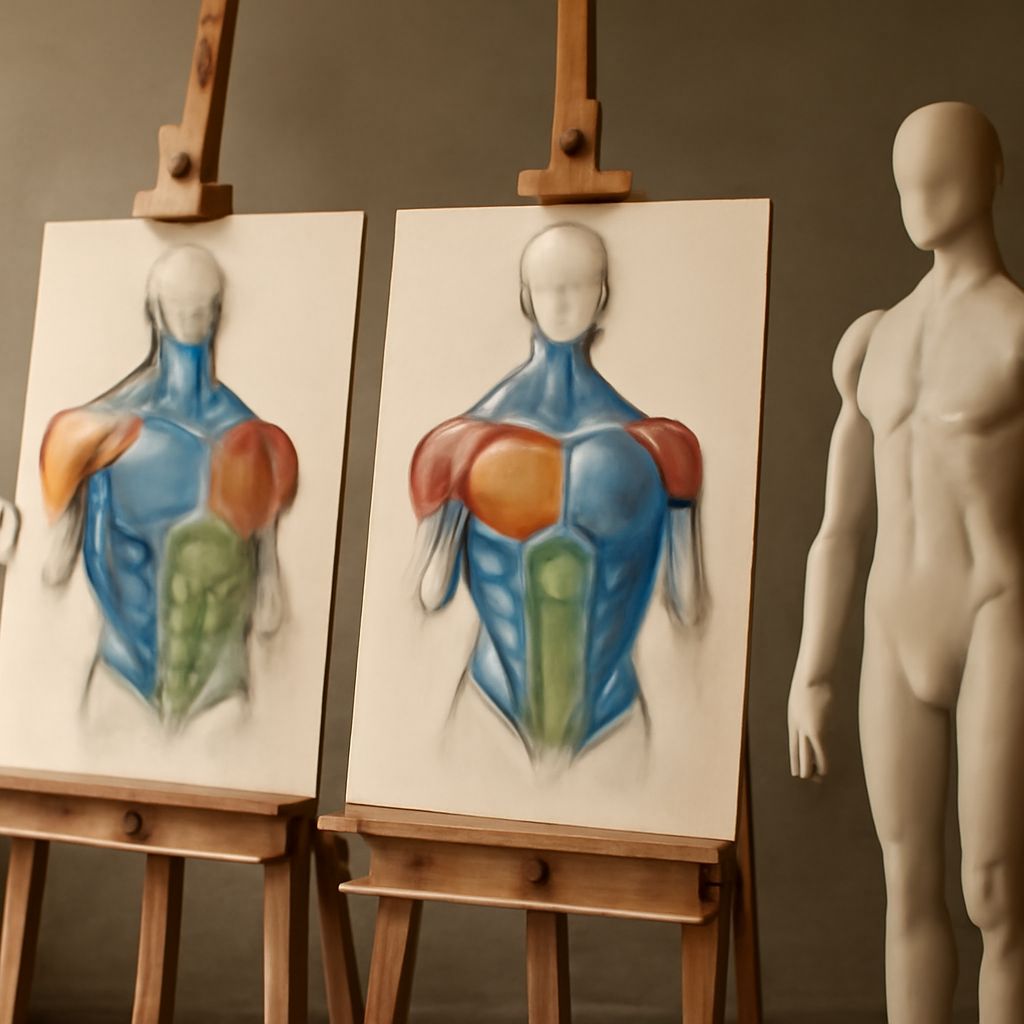
Blocking in Major Masses After the gesture, block in the three major masses: the rib cage (roughly an egg shape), the pelvis (a wedge or bucket shape), and the head (a sphere or egg). These three forms tilt, rotate, and shift independently of each other. Getting their relative positions right establishes the pose before any anatomy detail is added. Every effective figure drawing tutorial emphasizes this sequence for good reason.
Adding Limbs and Secondary Forms Limbs attach to the major masses at specific anatomical points. The arm attaches at the shoulder socket, not at the top of the shoulder surface. The leg attaches at the hip socket, deep within the pelvis. Drawing limbs as cylinders or simplified tubes before adding muscle detail keeps proportions manageable and avoids the tendency to make arms and legs too thin.
Anime Figure Drawing: Stylized Proportion
Anime figure drawing uses a distinctive proportional system that differs from realistic anatomy. Heads are larger relative to body height — often 1/6 or even 1/5 of total height rather than the realistic 1/7 to 1/7.5. Eyes are much larger, placed lower on the face than in realistic proportion, and simplified in their anatomy. Limbs are long and slender, and the torso is compact.
These conventions aren’t mistakes — they’re deliberate choices developed over decades of Japanese animation to maximize expressiveness in limited-animation production. Large eyes carry more emotional information per frame than realistically sized ones. Learning anime figure drawing means learning this specific visual language rather than trying to apply realistic anatomy rules to a style designed around different principles.
For figure drawing for beginners who want to work in anime style, starting with the simplified proportions of anime rather than realistic anatomy is a completely valid choice. You can always add anatomical complexity later; the expressive, gestural quality that anime figure work requires is a genuine skill in its own right.
Abstract Figure Drawing as Creative Practice
Abstract figure drawing strips the human form down to its essential energies — line, mass, and movement — without the obligation to accurately represent anatomy. Artists like Alberto Giacometti elongated figures into ghostly presences. Egon Schiele distorted proportions to emphasize psychological tension. Matisse reduced figures to flat color shapes with minimal interior detail.
Working with abstract figure drawing develops a different kind of observational skill — one focused on essence rather than description. Try a session where you draw the model using only three to five lines. Or work in pure silhouette, with no interior detail. Or reduce the figure to geometric masses with no curves. Each constraint forces you to identify what’s truly essential in a pose, which makes your realistic figure work more decisive and confident.
Practice Routines That Build Real Skill
Consistent practice beats occasional long sessions. For serious development as a figure artist, build a routine combining short gesture drawings — 30 seconds to 2 minutes — with longer structural studies of 10 to 20 minutes. Sites like Line of Action and SenshiStock offer free timed pose references suitable for any figure drawing tutorial approach.
Alternate between observational drawing from life or reference and construction-based drawing from imagination. Observational work builds seeing skills; construction work builds spatial reasoning. Together they create the ability to draw convincing figures without reference — the mark of an artist who has genuinely internalized figure drawing basics well enough to apply them freely.