Why does human figure drawing remain the cornerstone of art education across every tradition and century? Because drawing the human body trains observation, proportion awareness, and spatial reasoning simultaneously — skills that transfer to every other subject you’ll ever draw. Whether you’re starting from zero and learning how to approach drawing the body for the first time, working through a structured curriculum on drawing the human figure, or refining specific areas of your figure drawing practice, this guide provides a clear, progression-based approach. The human form has been studied by artists from ancient Greece through the Renaissance to contemporary illustration, and the accumulated understanding of how to draw human figure subjects effectively is both well-documented and highly accessible.
This article covers the foundational concepts, practice methods, and progression path that make human form drawing genuinely useful rather than frustrating, with specific attention to the structural approach that produces the most consistent improvement.
Foundational Concepts: Proportion and Structure
The Eight-Head Canon
The most widely taught proportion system for human figure drawing uses the head as the basic unit of measurement. In an idealized adult figure, the total body height equals approximately eight head lengths. This eight-head canon isn’t a rigid rule — real people vary significantly, and different artistic traditions use different proportions — but it gives you a reliable starting framework for checking your proportions before committing to detail work. The midpoint of the eight-head figure falls at the pubic symphysis (hip area), which surprises many beginners who intuitively place the midpoint much higher.
The Skeletal Armature
When you approach drawing the human figure, thinking about the skeleton gives you a framework that surface observation alone can’t provide. The skeleton determines how the body can and cannot move, where joints are located, and what the underlying volume of each body section looks like. You don’t need to memorize every bone — focusing on the key landmarks (shoulder girdle, ribcage, pelvis, knee and elbow joints) gives you enough structural understanding to draw human figure subjects in a wide variety of poses.
The Gesture Line
The gesture line is the single most important concept in figure drawing. It’s the dominant directional flow of the figure — the line you could trace from the top of the head through the torso and out through the weight-bearing leg, or from one shoulder through the hip to the opposite foot. Establishing the gesture line before any structural or surface detail keeps your figure drawings dynamic and alive. Artists who skip this step tend to produce static, posed-looking figures even when working from active reference.
Progressive Practice Methods
Gesture Drawing Sessions
Timed gesture drawing — thirty seconds to two minutes per pose — builds the core speed and fluency that longer studies can’t develop. Sites like Line of Action and SenshiStock on DeviantArt provide large libraries of timed pose references. In a gesture session, your goal isn’t a finished drawing — it’s capturing the essential movement and proportion of the figure in the fewest, most efficient marks possible. Ten minutes of timed gesture drawing before any longer figure study session reactivates your observation and loosens your mark-making.
Extended Pose Studies
After gesture work, extended pose studies — fifteen minutes to an hour — build your understanding of form, value, and surface anatomy. For a systematic approach to drawing the human figure, work through a sequence: gesture line first, then major body masses (head, ribcage, pelvis), then limbs as cylinders connecting the masses, then surface anatomy details only after the underlying structure is correctly established. This inside-out sequence is the approach taught in every serious atelier program because it produces structurally sound drawings efficiently.
Anatomy Studies
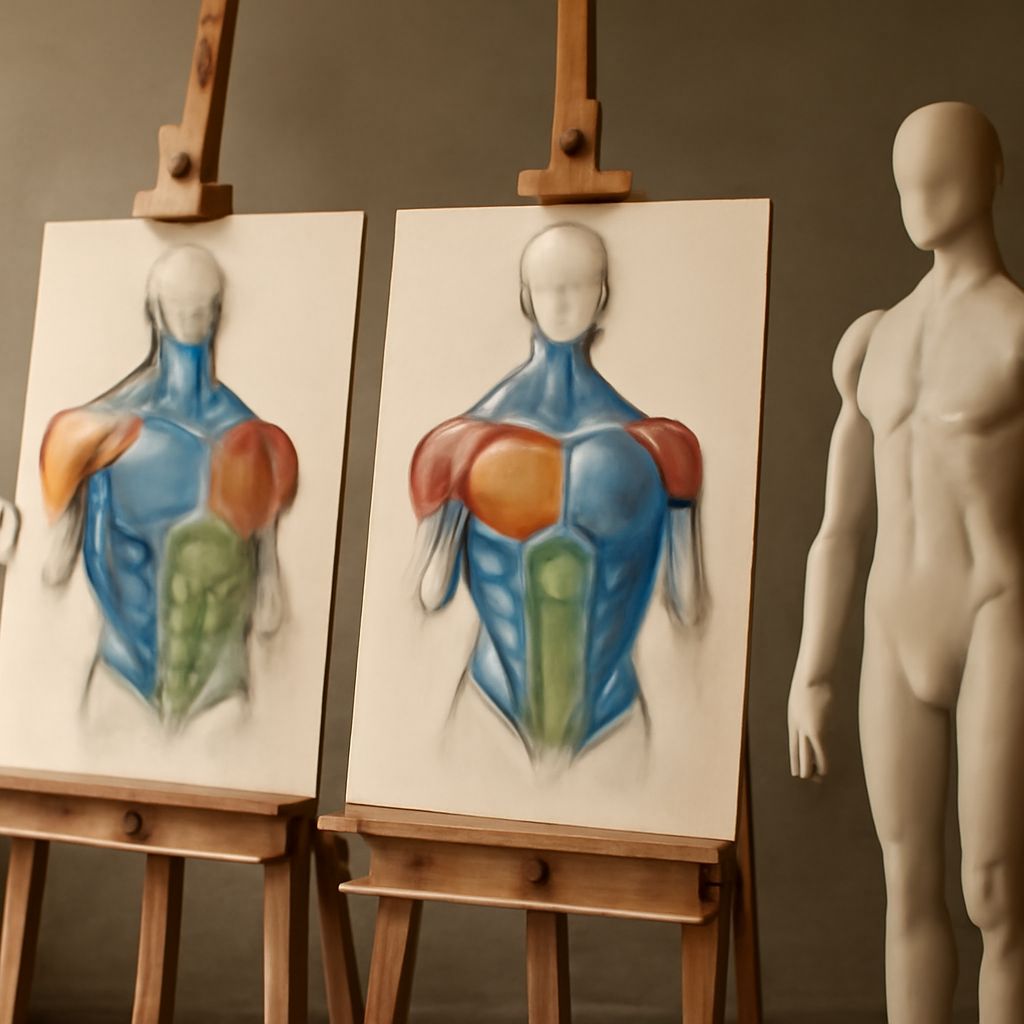
Human form drawing benefits enormously from periodic anatomy study sessions where you’re not drawing from a live model or reference photo but from anatomical diagrams. Studying how the pectoralis major attaches to the humerus, or how the deltoid wraps around the shoulder, or where the iliac crest sits relative to the waist — this knowledge shows up in your figure drawings as correctly understood bumps, transitions, and shadow shapes rather than approximations.
Common Problems and How to Fix Them
Stiff Poses
Stiff figures usually result from drawing the body as a series of symmetric, upright forms rather than using contrapposto — the classical pose where the weight shifts to one leg, tilting the pelvis and counter-tilting the shoulders. Human figure drawing that uses contrapposto immediately reads as more alive and naturalistic. Study how Renaissance painters and sculptors used weight shift and counter-rotation to create dynamic figures even in static standing poses.
Wrong Proportions in Foreshortening
Foreshortened figures — where a limb or body section points toward the viewer — consistently cause proportion errors because our conceptual knowledge of arm length fights with what we actually observe. The foreshortened arm looks much shorter than we expect. Trust what you see rather than what you know: if the forearm appears to be only two inches long at a particular angle, draw it at two inches, not six. Systematic trust in observed proportion over conceptual proportion is a learned habit that improves with deliberate practice.
Resources for Drawing Human Anatomy
The foundational resources for serious human form drawing study include Andrew Loomis’s Figure Drawing for All It’s Worth, Bridgman’s Complete Guide to Drawing from Life, Gottfried Bammes’s Figure Drawing, and for digital artists, Proko’s video curriculum on YouTube. Each takes a slightly different approach — Loomis emphasizes gesture and construction, Bridgman emphasizes anatomical landmark identification, Bammes emphasizes volume and solid form. Working through multiple resources gives you multiple conceptual frameworks for the same underlying subject, which deepens understanding more than any single source can.