Human Anatomy Drawing: Art, Reference, and Technique Guide
Why do so many skilled artists still dedicate years to studying the human body? Because human anatomy drawing is the foundation beneath every convincing portrait, figure, or character design — even highly stylized ones. When you understand the skeleton and muscle structure beneath the skin, you can draw people in any pose, from any angle, without needing a reference for every individual image. Human anatomy art has a history stretching from Leonardo da Vinci’s detailed dissection studies through today’s digital concept art — a continuous tradition of artists recognizing that this knowledge transforms everything.
This guide covers approaches to human anatomy drawings for practical artistic development, sources for human body anatomy drawing reference, and the method behind effective anatomical drawing that builds real, transferable skill rather than just copying finished work.
Why Anatomy Knowledge Changes Your Drawing
When you look at a photograph of a person and try to copy it without anatomical understanding, you’re copying shapes without understanding their cause. The bulge in the upper arm might be the biceps or the triceps depending on the pose — without knowing which muscle creates which form, you can’t predict how that area will look in a different pose. Anatomy knowledge turns observation into explanation.
Human anatomy drawing knowledge also allows you to correct errors in your reference. Photographs distort through lens perspective, lighting conditions create shadows that look like forms, and poses sometimes compress anatomy in misleading ways. An artist who understands anatomy can see through these visual accidents and draw what the body actually is rather than what the specific photograph shows.
Major Anatomical Systems for Artists
For human anatomy art purposes, two systems matter most: the skeleton and the superficial muscles. You don’t need the depth of knowledge a medical professional requires — you need the artist’s understanding of which structures create the visible surface forms that you draw.
Skeletal Landmarks
Certain bony landmarks are visible on the surface even on well-muscled figures: the clavicle, the sternum, the iliac crest (the ridge at the top of the pelvis), the greater trochanter (the bony point at the outer hip), the patella (kneecap), the tibial crest (shin), and the malleoli (ankle bones). Memorizing these landmarks and their locations in space gives you fixed reference points from which to build the rest of the figure.
Superficial Muscles
The deltoid, pectorals, biceps, and triceps define the arm and shoulder. The trapezius and sternocleidomastoid define the neck and upper back. The rectus abdominis, external obliques, and serratus anterior create the torso’s surface form. The gluteus maximus and quadriceps dominate the hip and thigh. For each muscle, know its origin, its insertion, and what movement it creates — then you can predict its form in any pose.
Approaches to Human Anatomy Drawings for Study
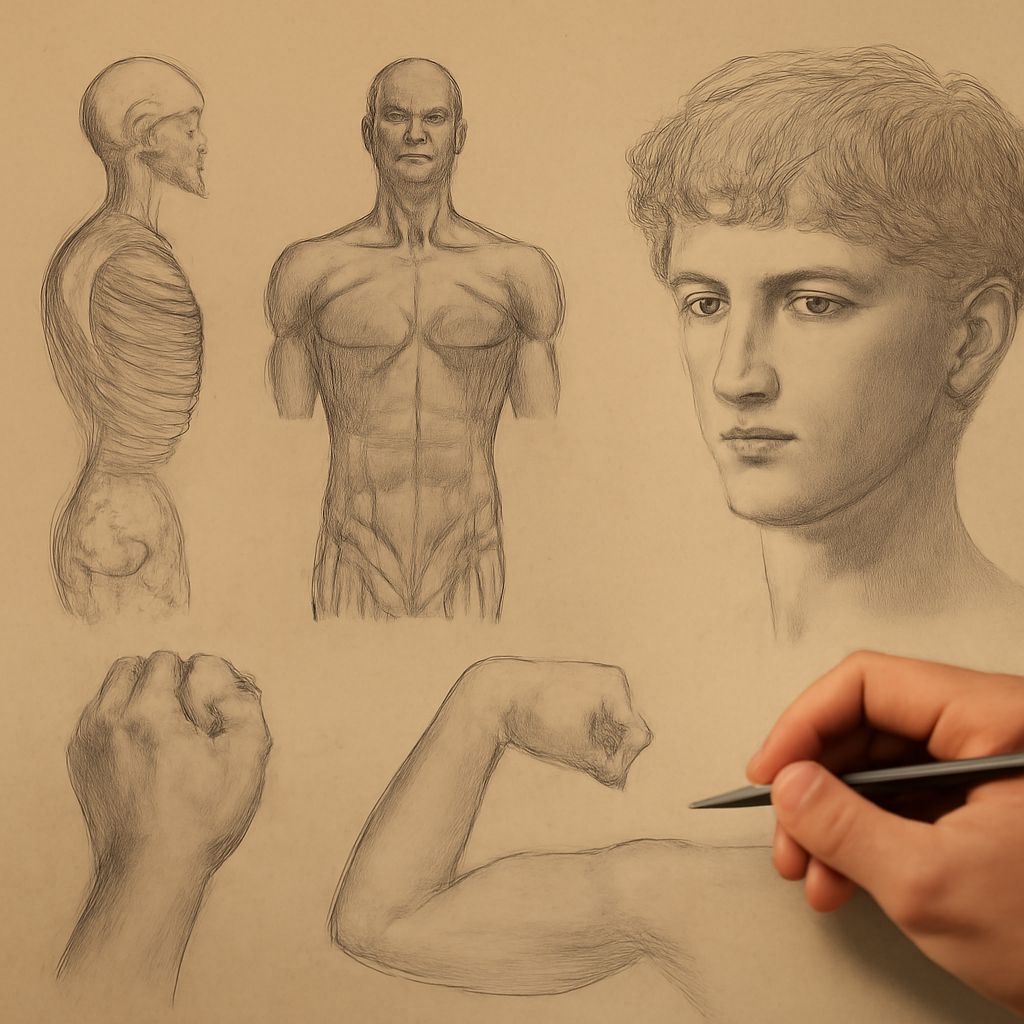
Effective human anatomy drawings for study purposes are not copies of anatomy textbook plates — they’re personal working documents you create to consolidate your understanding. The act of drawing forces active processing of the information rather than passive absorption.
Work through a body region systematically: draw the skeleton of the arm, then draw the same view with muscles added, then draw the surface form as it appears on a living figure. This three-layer approach, standard in classical atelier training, builds a mental model that you can access from imagination without external reference. Repeat for the torso, head, legs, and hands until each region is fully internalized.
Sources for Human Body Anatomy Drawing Reference
The best human body anatomy drawing references combine visual clarity with artistic orientation. Medical anatomy atlases like Gray’s Anatomy contain exhaustive detail but are organized for medical use rather than artistic application. Artist-specific anatomy books — Bridgman’s Complete Guide to Drawing from Life, Loomis’s Figure Drawing for All It’s Worth, Hogarth’s Dynamic Anatomy — present the same information prioritized for visual artists.
Online tools like Sketchfab offer three-dimensional anatomy models you can rotate to any angle, solving the problem of needing a reference for a specific unusual pose. Sites like Line of Action and SenshiStock provide timed live model references for gesture practice. For anatomical drawing of specific regions, medical illustration databases and museum digital collections of classical anatomy studies provide high-quality reference unavailable elsewhere.
Building a Personal Anatomy Study Practice
The most effective anatomical drawing practice is consistent and cumulative. Dedicate 20 to 30 minutes daily to focused anatomy study rather than occasional multi-hour sessions. Over months, this steady accumulation of specific, deliberate drawing creates genuine knowledge rather than surface familiarity. Track your progress by drawing the same subject — a standing figure, a hand, a head in three-quarter view — at regular intervals and comparing the results. The improvement visible in these comparison studies is one of the most motivating aspects of structured human anatomy art study.