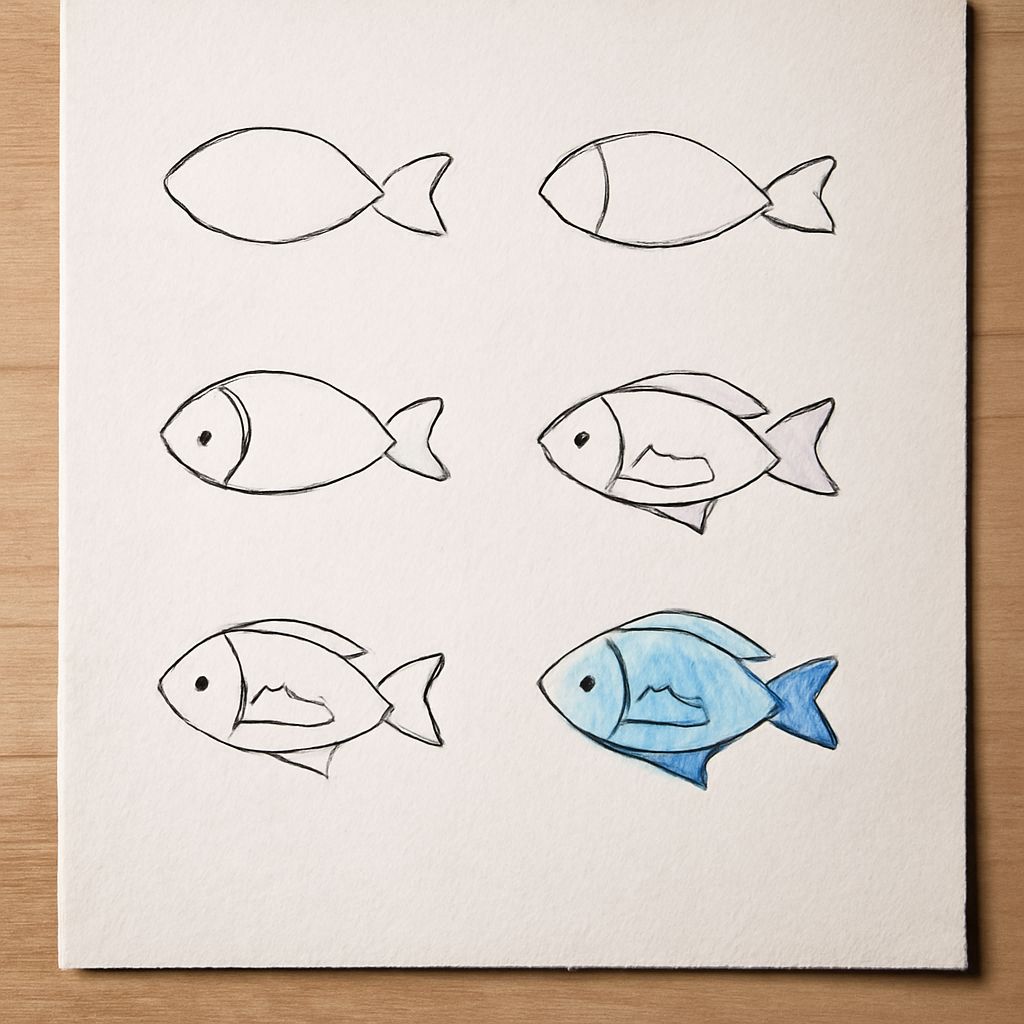
Drawing Exercises for Beginners: Basic and Simple Practice Methods
What should you actually practice when you are just starting to draw? The answer matters more than most beginners realize, because the wrong practice can build habits that are harder to unlearn than skills never learned at all. Drawing exercises for beginners that build foundational skills — observational accuracy, mark control, spatial reasoning, value understanding — produce cumulative progress that compounds over time. Beginner drawing exercises that focus on copying complex subjects without foundational knowledge produce frustration and premature discouragement. Drawing practice for beginners should begin where your actual skill level is, not where you wish it were. Basic drawing exercises provide the raw material from which every more complex skill is built. And simple drawing exercises that seem trivially easy often reveal unexpected weaknesses when done with genuine attention and intention.
This guide provides a complete set of foundational exercises organized by the specific skill each develops, with clear instruction on how to do each one productively.
Why Foundational Exercises Matter
Drawing exercises for beginners work because drawing is a skill built from sub-skills, each of which can be isolated and practiced deliberately. Mark control, proportion assessment, value reading, and spatial understanding are separable capabilities that can each be improved through specific targeted practice. Attempting to develop all of them simultaneously by drawing complex subjects leads to confusion about which component needs attention. Isolating each through specific basic drawing exercises builds competence in each area that then integrates naturally into complex work.
This approach is identical to how musicians practice scales before attempting concertos, or how athletes practice isolated movements before integrating them into competition. The isolation is not a detour from real drawing — it is the fastest route to real drawing capability.
Line Control Exercises
Control over your pencil or pen marks is the most fundamental of all drawing practice for beginners skills. Without mark control, you cannot accurately record what you observe regardless of how well you observe it. The following exercises build this control specifically:
- Parallel lines: Fill a page with parallel horizontal lines, spacing them as evenly as possible, using one continuous stroke per line. Repeat with vertical lines, then diagonal lines. The goal is lines that do not wobble, wave, or vary in pressure along their length.
- Graduated lines: Draw lines that start light, gradually increase to maximum pressure at the midpoint, then return to light. This develops pressure sensitivity essential for expressive mark-making.
- Ellipses: Draw smooth, consistent ellipses in a range of sizes and orientations. The ability to draw consistent ellipses is prerequisite to drawing cylinders, spheres, and most curved forms accurately.
These simple drawing exercises take ten to fifteen minutes and reveal mark control weaknesses immediately. The wobble in your lines is real information about the coordination that needs development.
Observational Accuracy Exercises
Beginner drawing exercises for observational accuracy train the eye-hand coordination that translates what you see into what you draw. The most fundamental exercise:
- Blind contour drawing: Draw the outline of any object without looking at your paper. Keep your pen moving at the same speed as your eye. The resulting drawing will look strange but reveals how accurately your hand follows your eye’s movement.
- Modified contour drawing: Same principle as blind contour but allow yourself to briefly glance at your paper when moving from one part of the subject to another. Produces more proportionally accurate results while maintaining the observational discipline of the pure blind contour method.
- Negative space drawing: Instead of drawing the object itself, draw the shapes of the spaces between and around the object. This forces a different kind of observation that bypasses symbolic thinking and records actual shapes.
These drawing exercises for beginners may seem abstract but address the most common drawing failure: drawing what you know rather than what you see.
Value and Tone Exercises
Value — the lightness or darkness of a tone — is what creates the illusion of three-dimensional form in drawing. Basic drawing exercises for value understanding:
- Value scale: Draw a row of five to nine boxes and fill each with an evenly graded value from white to the darkest tone you can produce. The ability to produce consistent, even gradations is prerequisite to all tonal rendering.
- Basic sphere shading: Draw a circle and shade it to appear as a three-dimensional sphere with a consistent light source. This requires understanding the light side, core shadow, reflected light, and cast shadow sequence that appears on any three-dimensional form.
- Object copying for value: Choose a simple object with clear light and shadow and copy only its values — ignore the outlines, draw only the patterns of light and dark using gradual, edge-to-edge shading.
These simple drawing exercises directly build the value vocabulary that makes all subsequent drawing more three-dimensional and convincing. Spend at least two sessions per week on value exercises for the first three months of drawing practice for beginners.