J Logo Design: Letter J Logo, Double M Logo, and Double D Logo Approaches
What makes a j logo visually distinct from other single-letter marks? The letter J has a characteristic descending curve that most other capital letters lack, and this feature creates both a design challenge and a unique opportunity. Whether you’re designing j logos for a personal brand, exploring how a letter j logo can carry a full identity, or studying how paired letter marks like a double m logo or double d logo achieve different effects, the principles of lettermark design apply across all of these applications.
This guide covers the specific visual considerations for a j logo, what makes j logos work in different industries and scales, how doubled-letter marks like the double m logo and double d logo create their distinctive visual effects, and practical advice for designing letter-based brand marks that hold up across all applications.
Design Principles for the J Logo
Working with the Descender
The J’s descending curve is its most distinctive feature and the element that makes a j logo challenging to design. Most capital letters sit on the baseline with consistent bottom edges, which makes them easy to contain in circular, square, or rectangular enclosures. The J’s descender breaks below the baseline, creating an asymmetry that either becomes a design asset or a compositional problem depending on how you handle it.
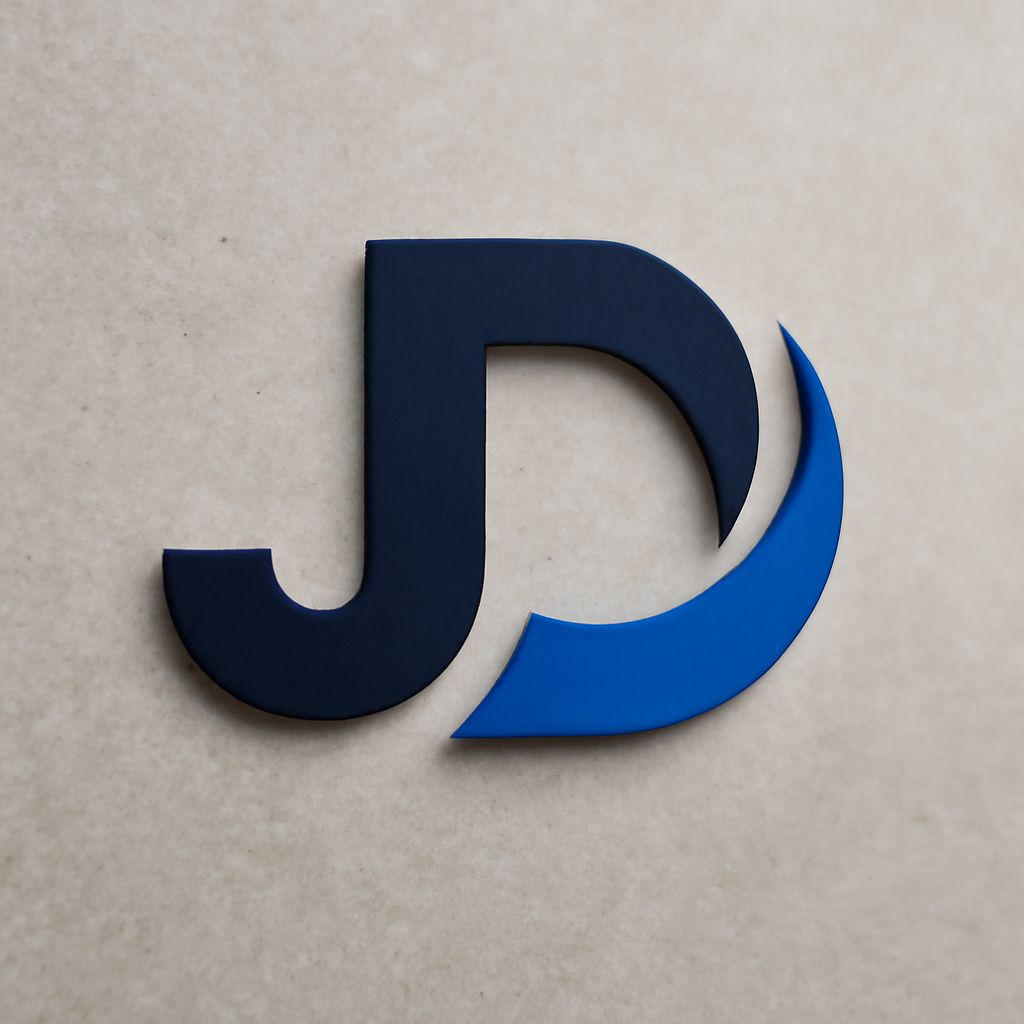
Successful j logos embrace the descender by using it as part of the design’s visual logic rather than hiding or truncating it. Some letter j logo designs extend the curve into an additional graphic element, like a wave, a fish hook, or a stylized base. Others use the descender to anchor the mark visually, giving it a sense of weight and groundedness that a purely symmetric letterform wouldn’t achieve.
Scale and Simplification
J logos must work at favicon scale, where a sixteen-by-sixteen pixel grid leaves very little room for detail. In this context, the J must reduce to its most essential form: a vertical stroke with a curve at the bottom. Any decorative elements that work beautifully at large display sizes need to survive this extreme reduction. Test your j logo at the smallest size it will appear before finalizing any detail decisions.
J Logos Across Industries
J logos appear across a wide range of industries, from financial services to fashion to technology. The letter’s visual character is relatively neutral compared to letters like Z or X, which carry stronger stylistic associations. This neutrality makes j logos flexible: they can be made to feel formal or casual, traditional or modern, depending on the typographic treatment you apply. Financial and professional services brands tend to use j logos with strong geometric or serif treatments. Fashion and lifestyle brands more often use j logos with calligraphic or flowing treatments that emphasize the natural curve of the letterform.
Double M Logo and Double D Logo: Paired Letter Marks
A double m logo creates visual interest through repetition and symmetry. Two M characters placed adjacent to each other can be arranged to create mirror symmetry, rotational symmetry, or interlocking patterns where shared strokes serve both letters simultaneously. The challenge with a double m logo is preventing the repeated vertical strokes of the letter from creating visual noise. Successful double m logo designs usually simplify the individual letters significantly or use interlocking to reduce the total stroke count.
A double d logo faces different challenges. The D’s characteristic curved side creates an opportunity for back-to-back or facing arrangements that create contained geometric shapes. Two D’s facing each other form a lens or eye shape. Two D’s placed back to back form a shape reminiscent of a diamond or barrel. These emergent shapes are often the most interesting element of a double d logo and worth exploring through multiple arrangement configurations before settling on a final direction.
Both the double m logo and double d logo approaches demonstrate a key principle of lettermark design: when you repeat or pair letters, the relationship between them becomes as important as the individual letterforms. Design the relationship first, and then refine the individual letters to serve that relationship.