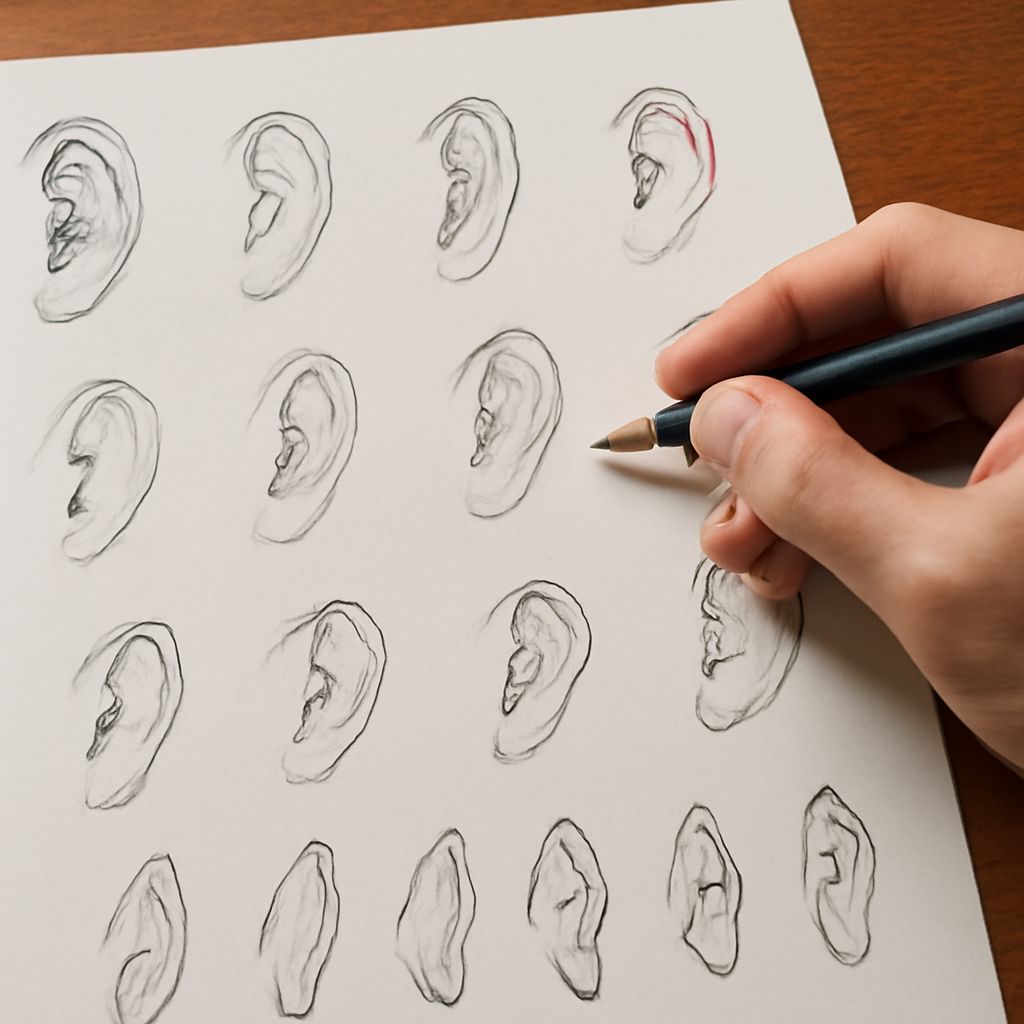
Drawing Ears: Reference Guides and Techniques for Realistic Results
Why do so many people find drawing ears more difficult than drawing eyes or noses? The ear’s structure is deceptively complex — a series of interlocking ridges, bowls, and channels that change dramatically depending on viewing angle. When you’re working from a portrait drawing reference, the ear often sits in the peripheral zone of the face where artists pay less deliberate attention. This guide gives you the structural framework to understand ears from any angle, shows how a horse drawing reference can train your eye for organic form in unexpected ways, covers what to look for in an ear drawing reference, and explores how a tree drawing reference develops the same branching-form thinking that helps with complex organic anatomy.
Once you understand the ear as a series of nested curves rather than a confusing blob, it becomes a genuinely interesting subject — and a detail that elevates portrait quality significantly when done well.
Understanding Ear Structure for Drawing
The Key Anatomical Components
The human ear has several distinct structural components that you need to identify before drawing ears convincingly. The helix is the outer rim that curls around the top and back of the ear. The antihelix is the inner ridge that runs roughly parallel to the helix. The concha is the deep bowl-shaped depression that leads into the ear canal. The tragus and antitragus are the small projections at the entrance to the ear canal. The lobule (earlobe) hangs below.
Understanding these named structures helps because it gives you specific elements to look for in any ear drawing reference you study. Rather than trying to copy a complicated shape, you’re identifying which component each part of the reference represents — and that cognitive organization dramatically speeds up your learning.
Ear Proportions and Placement
In most adult faces, the top of the ear aligns roughly with the eyebrow, and the bottom of the earlobe aligns roughly with the base of the nose. The ear tilts back slightly — its long axis is not perfectly vertical but leans away from the face by about 15 to 20 degrees. Getting this tilt right is the single most common fix needed when drawing ears from imagination or from a portrait drawing reference. Most beginners place ears too upright, which makes faces look oddly flat.
Using Reference Effectively for Ear and Organic Form Drawing
Working from an Ear Drawing Reference
An effective ear drawing reference should show the subject from multiple angles — front, three-quarter, profile, and rear. Front-view ears look very different from profile ears because you’re seeing completely different structural elements in each view. Many artists collect a library of ear reference photos from multiple angles specifically for this reason. When you encounter an ear in a portrait that doesn’t quite work, flipping to a different angle of the same form often reveals what’s actually happening with the structure.
Practice drawing ears in isolation before putting them on full portraits. Fill a page with ears from different angles and lighting conditions using your ear drawing reference collection. This focused repetition builds the pattern recognition that makes ears feel automatic rather than effortful when they appear in a full portrait context.
Horse and Tree Reference for Organic Form Training
A horse drawing reference trains your eye for organic forms in ways that complement portrait work. Horses have large, expressive ears that move independently and change shape dramatically depending on the animal’s mood and attention direction. Studying a horse drawing reference from the front shows how ear form creates the overall head silhouette — a skill that transfers directly to understanding how human ears affect a portrait’s profile view.
A tree drawing reference develops the same branching-form thinking that helps with any complex organic structure. Trees and ears share an important visual logic: main forms divide into secondary forms, which divide into tertiary details, all following a coherent internal hierarchy. When you study a tree drawing reference carefully — learning to see the trunk’s relationship to main branches, which relate to smaller branches, which end in twigs — you’re practicing the same hierarchical form-reading that makes complex anatomy like ears understandable rather than overwhelming.
Portrait Drawing Reference and Integration
Once you’ve built confidence with isolated ear studies, integrating them into a full portrait drawing reference exercise reveals whether you truly understand ear placement in context. The ear in a three-quarter portrait view is particularly revealing: you need to draw the ear partially in profile while the rest of the face reads as three-quarter, and the spatial relationship between ear and face must feel three-dimensional. Good portrait drawing reference material shows this relationship clearly — look for references where the ear’s spatial separation from the face reads convincingly.
Next Steps
Spend one focused week drawing nothing but ears — from your ear drawing reference collection, from mirrors, and from imagination. At the end of the week, put an ear on a full portrait study and assess how naturally it integrates. Then move to a challenging three-quarter portrait with both ears visible at different angles. Use your portrait drawing reference library to check your work, and return to isolated ear practice any time a specific angle continues to give you trouble.