Axon Drawing Techniques and How to Master Comic Book Style Drawing
What separates a flat sketch from a panel that feels like it could leap off the page? The answer usually comes down to fundamentals — perspective, line weight, and structure. Axon drawing, short for axonometric projection, is one of those foundational techniques that gives your compositions measurable depth without requiring full three-point perspective. It’s worth learning on its own, and it connects directly to the kind of spatial thinking that makes comic book style drawing so convincing.
Whether you want to master drawing comic book characters with proper anatomy and dynamic poses, or you’re focused on drawing comic characters with expressive faces and readable silhouettes, the skills overlap more than you’d expect. The ability to think in three dimensions and draw comic book style with confidence starts with understanding how space and line interact on the page.
What Is Axon Drawing and Why It Matters
Axonometric Projection Basics
Axon drawing uses parallel projection lines rather than converging ones. In standard perspective, lines converge toward one or more vanishing points on the horizon. In axonometric projection, parallel lines stay parallel across the entire drawing. This approach is popular in technical illustration, architectural visualization, and isometric game art because it preserves accurate proportions at every point in the image.
Using Axon Lines for Comic Panels
In comics, axon drawing appears most often in establishing shots and architectural environments. When you want to show a city block, a villain’s lair, or a science lab with a clear sense of three-dimensional space, axonometric layouts give you control and consistency. Every element stays in proportion, so the reader can read the space at a glance. Background artists for animated features and comic studios use this technique constantly.
Perspective Without Vanishing Points
One practical advantage of axon drawing over traditional perspective is speed. You don’t need to locate vanishing points on the horizon before drawing every line. Set your angle — typically 30 or 45 degrees — and maintain it throughout. This consistency makes axon projection especially useful for repeat environments, like a character’s apartment that appears across multiple issues.
Core Principles of Comic Book Style Drawing
Line Weight and Inking
Comic book style drawing lives or dies on line weight variation. Heavy outlines on figures separate them from backgrounds. Thin lines inside the figure define form and detail. The thickest lines typically fall on the shadow side of figures and along the silhouette edge. A figure drawn with uniform line weight reads as flat and unfinished. Vary from 0.3mm for interior details to 1mm or heavier for outer contours.
Dynamic Posing Fundamentals
Drawing comic book style means drawing action. Comics communicate movement through freeze-frame moments — the instant before a punch lands, the peak of a jump, the moment of discovery. Choose poses that tell the story from their silhouette alone. If you cover the details and the silhouette still reads clearly, the pose works. Study action photography and martial arts reference to build a library of dynamic body positions.
Facial Expression in Comics
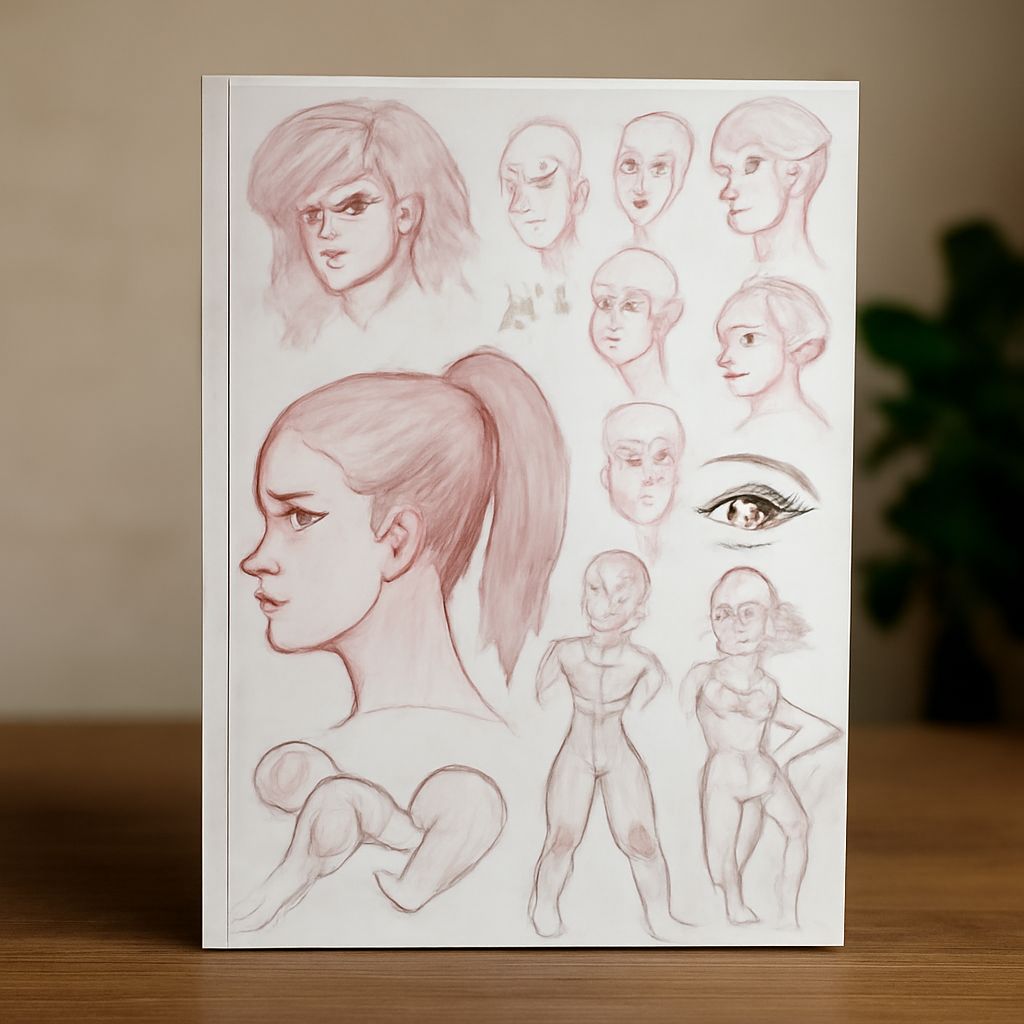
Drawing comic characters with readable expressions requires exaggeration. Real facial expressions are subtle. Comics compress and amplify them. Brow angle, mouth shape, and eye size do most of the work. Practice the six primary expressions — happiness, sadness, anger, fear, surprise, disgust — in your character’s specific face design. Each character’s expression set should feel consistent with their design even as the emotion changes.
Drawing Comic Book Characters Step by Step
Sketching Body Proportions
Superhero comic proportions typically run eight to nine heads tall, compared to the realistic seven and a half. This slight elongation creates an idealized, powerful silhouette. Block out the figure with simple shapes first — torso as a wedge, pelvis as a box, limbs as cylinders. Get the gesture right before committing to anatomy. The figure’s rhythm and weight distribution matter more than detail at this stage.
Costumes and Accessories
Drawing comic book characters means designing wearable visual identity. Costumes need to read clearly at thumbnail size and hold up at full-page splash scale. Use bold silhouette-defining shapes — capes, shoulder pads, masks — and limit your color palette to three or four colors maximum. Every accessory should either explain the character’s power, occupation, or personality, or it probably doesn’t belong on the design.
Inking and Coloring Tips
Ink over clean pencils using confident, single-stroke lines. Avoid scratchy, repeated strokes — they read as uncertainty on the page. For digital inking, use a stabilized brush set to 60-70% smoothing to get clean curves. When coloring in comic book style, use flat base colors first, then add a single shadow layer using multiply blending. Keep highlights minimal and geometric.
Bringing It All Together: Drawing Comic Book Style
Panel Composition
Drawing comic book style means thinking in sequences, not single images. Each panel is a cut in a film. Use wide establishing shots, medium shots for conversation, and close-ups for emotional impact. Vary your panel sizes to control pacing — larger panels slow the reader down and signal importance, while smaller panels speed up action sequences.
Action Lines and Motion Blur
Speed lines, impact bursts, and motion blur are the visual language of comics. These graphic elements have no photographic equivalent — they’re purely a comic book invention that communicates force, speed, and impact more directly than any realistic approach. Practice drawing radiating lines from a single point for impact effects, and parallel speed lines for rapid lateral movement.
Color Theory for Comics
When drawing comic characters in full color, use color temperature to create depth. Warm colors advance and cool colors recede. Your foreground figures can carry warm skin tones and saturated costume colors, while backgrounds shift cooler and less saturated. This temperature separation reads as spatial depth even without perfect perspective construction. It’s one of the fastest ways to make drawing comic book style look professional.